 |
|
| Crowdfunding Offering Type: | Regulation CF |
| Security Type: | SAFE (Securities Agreement for Future Equity) |
| Amount Available: | $5 million |
| Minimum Investment Amount: | $250 |
| Offering Valuation: | 20% discount to an $80M pre-money |
| Availability: | Open to U.S. Domestic and International |
| Industry: | Aerospace/Autonomous Tech |
| Offering Platform: | Republic (https://republic.com) |
| Link to Deal: | https://republic.com/mightyfly |
One of the single-largest technological trends that will define 2026 will be automation and autonomous technology.
I’m not referring to software-based automation along the lines of what companies like UiPath (PATH), Salesforce (CRM), Service Now (NOW), and many others have been building their businesses on over the last several years with the employment of machine-learning technology.
I’m referring to manifested forms of intelligence that come to life in a robotic forms, capable of navigating and interacting with and in the real world – autonomously.
The combination of advanced semiconductors, software, and robotics technology have enabled robotic systems to solve critical problems in labor shortages, and most importantly, improve efficiencies by removing friction in previously complex and expensive operations.
This has always been one of my most important and profitable investment theses in any investment opportunity.
Next year will be a remarkable year in this regard.
It will be visceral. It will be tangible. And it will be easy for even non-technologists to grasp the significance of what is happening in high-tech right now with regards to AI, robotics, and autonomous technology.
Millions of full self-driving Teslas are already on the road, having driven more than 6.4 billion miles autonomously.
And the safety statistics are both incredible and definitive: Tesla’s autonomous technology is proven to result in 7X less collisions compared to human drivers.
Not only will Teslas get to the stage where passengers can take a nap while they are teleported to their destinations, Tesla’s Cybercab will be manufactured at scale beginning April of next year… and then will be deployed in cities around the U.S.
Humanoid robots will also enter mass production by a handful of robotics companies, including Figure AI, 1X Technologies, Tesla, and others. “They” will navigate our world on foot, performing valuable and useful functions in industrial settings, logistics centers, healthcare facilities, and even our homes.
And thanks to some positive changes in regulatory support by the current administration, airborne robots – autonomous drones – will be seen shuttling cargo and passengers from point to point radically improving efficiencies for businesses, reducing costs, and of course bringing convenience on a level we simply having seen before.
Which brings us to our Day One recommendation – MightyFly.
MightyFly is an autonomous robotics technology company based out of San Leandro, California just south of Oakland, CA on the San Francisco Bay.
The company has developed a tandem wing aircraft, meaning two wings, on both the fore (front) and aft (rear) of the aircraft as shown in the picture below.
This is designed specifically for stability in flight to better manage weight distribution of the cargo contained within its hull.
Packages are simply loaded and unloaded into the MightyFly hull via an internal conveyor belt that ingests the packages. 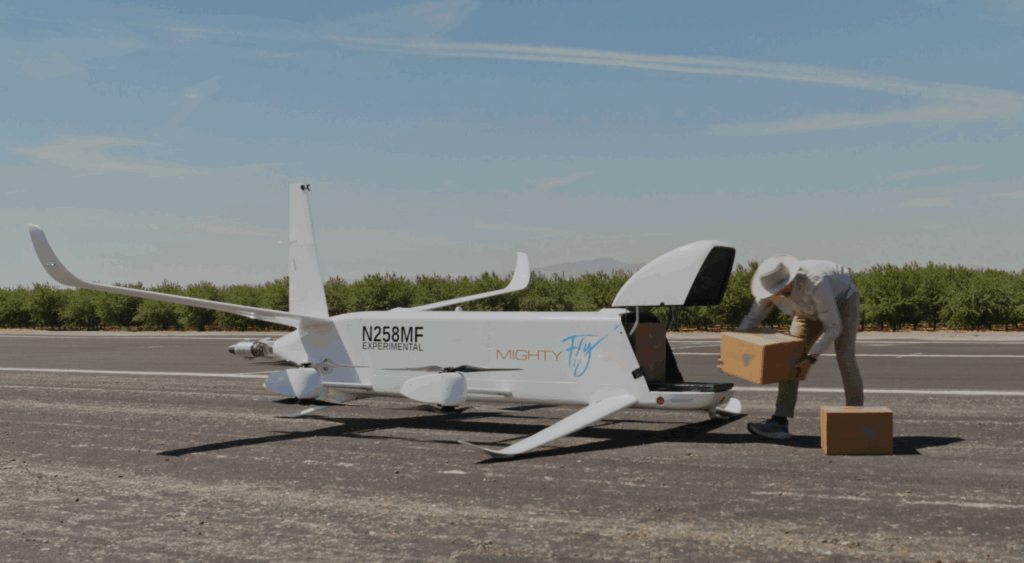 Source: MightyFly
MightyFly’s aircraft is designed as a hybrid gas/electric vertical take-off and landing (eVTOL) aircraft targeting the expedited delivery market which is worth around $320 billion and growing.
MightyFly’s aerospace technology not only has commercial applications, but also obvious applications for logistics and delivery in military applications providing reliable, autonomous, long-range cargo delivery eVTOL aircraft capable of landing pretty much anywhere on the ground, or on a rooftop.
Its hybrid gas/electric engine is a smart engineering choice, as it reduces overall emissions, and preserves range a payload capacity enabling 600-1,000 mile range and 100-500 pounds of cargo.
The best way for us to view MightyFly is as an autonomous business-to-business (B2B) service company. The team at MightyFly has structured their business model in a way to lower any obstacles for adoption, by making it simple to partner with MightyFly to solve their expedited delivery needs.
MightyFly structures their contracts with their customers in a way that speeds up adoption by providing expedited deliveries as a service for its customers.
This requires a monthly fee, which is negotiated based on required delivery volumes in addition to a per package delivery fee.
In this way, MightyFly can ensure that its fixed operating expenses are covered, as well as the ability to generate additional cashflow with each delivered package.
Target customers are along the lines of:
MightyFly is disrupting the expedited delivery industry by solving its most critical pain points:
MightyFly uses GPS sensors, an internal measurement unit (IMU) to measure an aircraft’s motion and state in real-time, and a magnetometer that measures the Earth’s magnetic field to determine heading and orientation for autonomous navigation of the eVTOL aircraft.
The aircraft also has sensors and radar to detect and avoid any obstacles, as well as cameras that enable the aircraft to “see” and verify the landing zones and safely delivery its cargo at the desired location.
What makes MightyFly’s autonomous technology so attractive is that it is capable of providing same-day deliveries starting at $50 a package compared to the $400-plus rates for air/ground-based expedited services.
Equally important is that MightyFly’s hybrid gas/electric propulsion design results in 92% less CO2 emissions compared to small aircraft deliveries, and 64% less CO2 emissions compared to combustion engine delivery vehicles that are most common today.
And it goes without saying that because MightyFly’s autonomous technology is designed for point-to-point expedited deliveries, the speed in which packages can be delivered is multiples faster than any ground-based network.
And without the cost of drivers/pilots, operational expenses are reduced significantly resulting in both lower delivery costs for MightyFly’s customers as mentioned earlier, and an estimated 70% gross margins for MightyFly when it is operating at scale.
I’ve been bullish on autonomous flight technology, particularly as applied to logistics and delivery, for years now. But there was one thing that was holding the industry back…
The regulatory environment.
Specifically, with very limited exceptions, this kind of autonomous drone technology was not permitted to operate beyond visual line of sight (BVLOS).
Now, I’m sure it’s easy to understand that this is a major problem. If a company like MightyFly would need to have a human operator present with a visual line of sight for every delivery, it defeats the purpose of autonomous delivery. It’s impossible to scale and far too costly.
But this June, everything changed…
On June 6 this year, President Trump issued Executive Order #14307 – Unleashing American Drone Dominance – designed to radically improve the regulations surrounding Unmanned Aircraft Systems (UAS), which include vertical takeoff and landing (VTOL) aircraft, to accelerate the commercialization of autonomous drone technology for both cargo and passenger applications in both the public and private sector.
 Executive Order for Drone Technology | Source: The White House
Importantly, the executive order gave explicit directions regarding enabling beyond visual line of sight (BVLOS) operations. Specifically:
The above directions in the executive order were directly responsible for quick action by the FAA and the establishment of regulation Part 108, which is designed to normalize and enable BVLOS operations for unmanned aircraft systems (UAS), otherwise known as drones of any kind large or small.
Part 108 specifically provides for autonomous flights for both commercial and defense applications, as well as for both cargo and passenger operations through controlled airspaces. The 60-day public comment period ended just recently, on October 6 this year, and the final regulation is expected to be put in place in the March/April 2026 timeframe.
The implications of Part 108 for MightyFly are incredible.
Historically, aerospace companies would have to go through a multi-year process with the FAA to earn a type certification for a new aircraft. This has notoriously been a bureaucratic and rigorous process that costs millions of dollars and an incredible amount of time and effort for any company to go through.
Because of that, it favors larger aerospace companies with lots of resources.
But with part 108, MightyFly no longer is required to have type certification, which means a whole lot less capital and time to get the approvals to begin commercial operations with its autonomous cargo aircraft.
The positive impact on the UAS industry of Part 108 was immediate, palpable, and extremely exciting.
Just have a look at what happened to Joby Aviation’s (JOBY) stock on the back of the executive order. Joby’s stock rose 169% in less than two months. Joby is now trading at an $11.7 billion valuation.
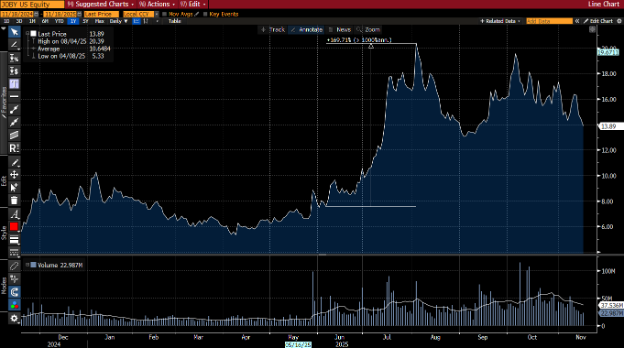
Joby Aviation (JOBY) 1-Year Chart | Source: Bloomberg
The reason for the spike in Joby’s share price is that Joby’s long-term goal is to develop autonomous drone technology designed to shuttle passengers in eVTOL aircraft for both commercial and defense applications.
Joby had been pursuing a piloted eVTOL as its go-to-market strategy, simply because the regulations didn’t exist for BVLOS autonomous flight operations.
Now, everything has changed for the industry for companies like Joby and MightyFly, and MightyFly is an autonomy-first aerospace company.
This regulatory shift provided an opening for Beta Technologies (BETA), which was previously a private company that had raised $1.72 billion in venture capital, to go public early this month. BETA has developed piloted passenger-sized eVTOLs designed for cargo transport. Like Joby, BETA employed the same go-to-market strategy, intending to migrate to autonomous flight in the future.
BETA’s eVTOL has a cargo capacity of 200 cubic feet, a maximum payload of 1,250 pounds, and a range of about 250 miles. For comparison, MightyFly’s hybrid VTOL has a capacity of 100-500 pounds of payload and a range of 600-1,000 miles.
Beta is now trading at an $8.6 billion valuation. And MightyFly is a far more versatile solution from my perspective.
Dramatically longer range and a lot of versatility in terms of cargo carrying capacity.
While these two companies aren’t really going to compete against each other, as they’ll service different segments of the market, Beta is still a useful comparison in terms of business potential and future valuation.
Competitively, I consider MightyFly to sit in the sweet spot of technology and business economics. It is the only fully autonomous large cargo VTOL (i.e. cargo greater than 100 lbs.) with low capex requirements and long-range, multi-stop capabilities.
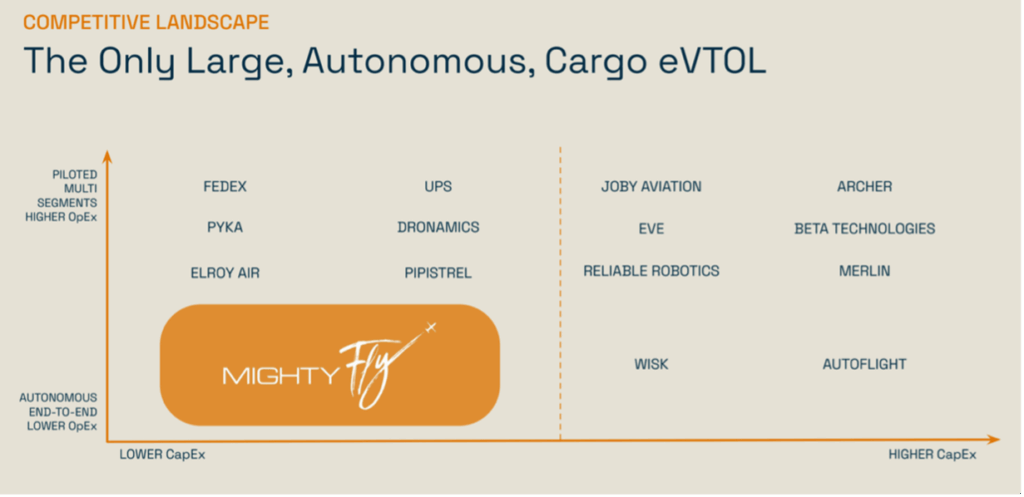 Autonomous VTOL Competitive Map | Source: MightyFly
MightyFly’s ability to operate in a fully autonomous mode from origin to destination equates to low-operational expenses, which enables lower costs per package delivery.
Its hybrid engine design was a smart engineering decision, as it results in lower weight than an entirely electric propulsion design (because lithium-ion batteries are very heavy and reduce cargo capacity).
And the combustion side of the engine runs on 91 octane gasoline, which is a whole lot cheaper than jet fuel. The national average for jet fuel is $6.46 a gallon compared to 91 octane which is around $3.58 a gallon.
It’s MightyFly’s ease-of-use, low capex, and low opex that is driving its business success with customers.
The company has already signed a series of LOIs (letters of intent), which are common in the aerospace engineering industry when developing a novel technology for commercial deployment. It helps early-stage companies raise additional capital to meet critical development milestones, and once those milestones are met, the likelihood of commercial deployment increases with those LOI customers.
To that end, MightyFly has:
This is just a small indication of MightyFly’s business pipeline.
Even more tangible is a contract that MightyFly just signed in the last few weeks, worth $50 million, for expedited deliveries for another healthcare services company. I’m particularly excited about this deal as the business case makes so much sense.
The return-on-investment for the healthcare company is almost immediate, and this contract is large enough to help MightyFly drive some scale in its business, and it will act as an excellent real-world reference account for future customers.
MightyFly is currently raising a $5 million Reg CF raise at almost the same valuation as its last venture capital funding (last raise was this April at a 20% discount to an $80 million post-money valuation).
Over the last five years, MightyFly has raised around $10 million from some very well-known venture capital firms in Silicon Valley like Draper Associates, At One Ventures, and Graph Ventures, as well as Halogen in Los Angeles.
What I’m most impressed with is how well MightyFly has used the funds that it raised. The team was scrappy and prudent with the capital it raised and has iterated on its aerospace and autonomous technology – now on its 3rd generation autonomous cargo drone – all accomplished in the last three years.
This Reg CF offering by MightyFly is structured as a SAFE (securities agreement for future equity) at a 20% discount to an $80 million pre-money valuation. That equates to a $64 million pre-money valuation.
As a reminder, MightyFly just signed a multi-year $50 million contract. That single deal is almost as much as the valuation of this offering.
I fully expect that within the next 12-18 months, MightyFly’s pipeline of LOIs/MOUs will exceed $500 million. MightyFly’s business pipeline and business model have clear potential to be generating $100 million in revenues in the 5- or 6-year timeframe. And gross margins should be in the 70-80% range, which means that there is a path towards generating free cash flow within the next few years.
And a $100 million high-growth technology business – with 70-80% gross margins – typically raises capital or gets acquired at valuation multiples around 10X annual sales.
That means that MightyFly has the potential for a $1 billion-plus valuation in that timeframe.
And if we look at little farther out, towards the 2034-2035 timeframe, this could easily be a business generating more than $500 million, which means we could be looking at a $5 billion-plus valuation.
Base case, however, at a $1 billion valuation would mean a 15.6-times increase in valuation for MightyFly. At $5 billion, it would be a 78-times increase.
It goes without saying that such a high-quality, venture-backed company like MightyFly tends to raise larger and larger rounds from notable venture capital firms like the ones I mentioned earlier.
This deal required a lot of hard work on my part in working with the CEO of MightyFly to enable this Reg CF offering.
Our very first conversation was more than a year ago.
We had a great connection as, like me, the CEO has a background in aeronautical and astronautical engineering. I went to Purdue University, and she did both her undergrad and graduate work at MIT and Stanford.
Over the last year or so, she was able to see the value of raising capital through Reg CF regulations and how a broader, diverse investor base could potentially help MightyFly achieve its goals. Sometimes the best deals take an extraordinary amount of work, this is definitely the case with MightyFly.
To be completely honest, I was a little worried that a larger venture capital firm was going to swoop in and take the Reg CF offering off the table after MightyFly signed its $50 million contract. This is absolutely an institutional-quality company.
And as I mentioned before, this industry finds itself at this incredible regulatory inflection point that just happened in the last few months. The new regulations in support of beyond visual line of sight autonomous VTOL aircraft has completely unlocked the potential of the entire industry.
And the Part 108 regulations enable MightyFly to get certified for commercial operations without having to go through the extremely long and capital-intensive process of FAA type certification.
We have a positive regulatory tailwind, a 3rd generational aerospace product, autonomous technology, a low barrier to entry go to market strategy, and a highly differentiated service offering for expedited delivery – and an industry with major pain points that MightyFly solves.
That’s why this is such a fantastic private investment opportunity. We’re getting in right before the MightyFly’s commercial operations start to experience exponential growth. And it goes without saying that this will be our only opportunity to get an allocation to MightyFly. After this, I expect a large institutional round by a prominent venture capital firm.
Beta Technologies (BETA) was able to become an $8.6 billion publicly traded company as a piloted eVTOL cargo company. There is no reason that MightyFly can’t do the same.
MightyFly makes a great addition to our Day One model portfolio. We gain exposure to an aerospace engineering company that is innovating in one of the biggest technological trends of the next few years – autonomous robotics technology.
Artificial intelligence, autonomy, and robotics are going to be the technologies that will drive the largest economic boom in history, which is why I’m excited to gain exposure to this exciting trend in Day One Investor.
Action to Take: Invest in MightyFly on the Republic crowdfunding platform, the link to the investment website can be found here:
https://republic.com/mightyfly
Please Note: This is a $5 million Reg CF offering. This is the maximum that can be raised in in a Reg CF crowdfunding deal. Once $5 million has been hit, there is no more allocation, so please reserve your allocation quickly if you would like to have an interest in MightyFly. Once a Reg CF deal fills up, it’s gone. All you can do is enter a waitlist in case another investor doesn’t complete their investment.
This investment is open to all investors, accredited and non-accredited, and is open to both U.S. and international investors. In the U.S., ACH transfers are the easiest, but credit cards are also OK. And for international investors, both wire transfers and credit cards are fine for making the investment.
If any subscribers have issues reserving their investment, please reach out directly to the following email address: investors@republic.com. Alternatively, subscribers can speak with a Republic representative at +1-347-418-0949.
Also, please note that investors domiciled in the Canadian provinces of Alberta, Ontario, and Quebec will not be able to participate in this offering. That’s because of restrictive regulations around private investments specific to those provinces. This is something that’s completely outside the purview of MightyFly and Republic.
As a reminder, this recommendation involves an investment in a private company through a Regulation Crowdfunding (Reg CF) offering. Investing in private companies is fundamentally different from purchasing shares of publicly traded companies.
There is no public market for these securities. You should expect to hold this investment for an indefinite period – potentially many years – with no ability to sell or liquidate your position as you would a publicly traded stock.
Unlike publicly traded stocks that can typically be sold on an exchange within seconds, private company investments generally have little or no secondary market. You cannot simply “cash out” when you want or need your money back.
For these reasons, please remember that we should always keep our position sizes rational for these early-stage deals.
The absolute worst thing a private investor can do is go “too heavy” on one early-stage private investment. The smartest angel investors I know always balance their portfolios with rational investment sizes over a larger number of companies. This is the very best way to diversify risk in a highly risky asset class.
So let’s make sure we are allocating our capital wisely to each position.
My guidance for MightyFly is for subscribers to invest no more than 20-25% of what they normally put into a small-cap tech stock.
For instance, if we normally invest $10,000 into a small-cap stock like the ones I recommend in Exponential Tech Investor at Brownstone Research, then we should invest no more than $2,000-2,500 in MightyFly.
If we’d normally invest $1,000 in a small-cap technology stock, our position size would be around $200-250.
This speaks to something I’ve said before – every recommendation I’ll make in Day One Investor is different. We are going to be strategic with our capital allocation plans.
That said, we should never invest any more than we are willing to lose in a single, early-stage private investment. No matter how much diligence we perform or how well I know the industry, company, and technology, there are simply too many unknown variables outside of our control when investing at such an early stage.
That’s why our goal is to build a large portfolio of exciting, high-growth companies with fantastic founders and incredible growth potential over a wide range of industries.
These investments will take place over a number of years. And we want these companies to stay private, thrive, receive additional funding, and eventually grow into multibillion-dollar companies. All it takes is one unicorn ($1 billion valuation or more) to drive outsized returns in a portfolio.
Action to Take: Invest in MightyFly at Republic.
Please go to the following URL to reserve your place in MightyFly’s Reg CF offering as soon as possible.
https://republic.com/mightyfly
This investment opportunity will fill up fast, likely within 72 hours of publishing my research. So please don’t wait. Investing in private deals isn’t the same as investing in a publicly traded company.
High-quality deals simply don’t last long, and once the $5 million allocation is taken, there is nothing left.
Regards,
Jeff Brown
Editor, Day One Investor